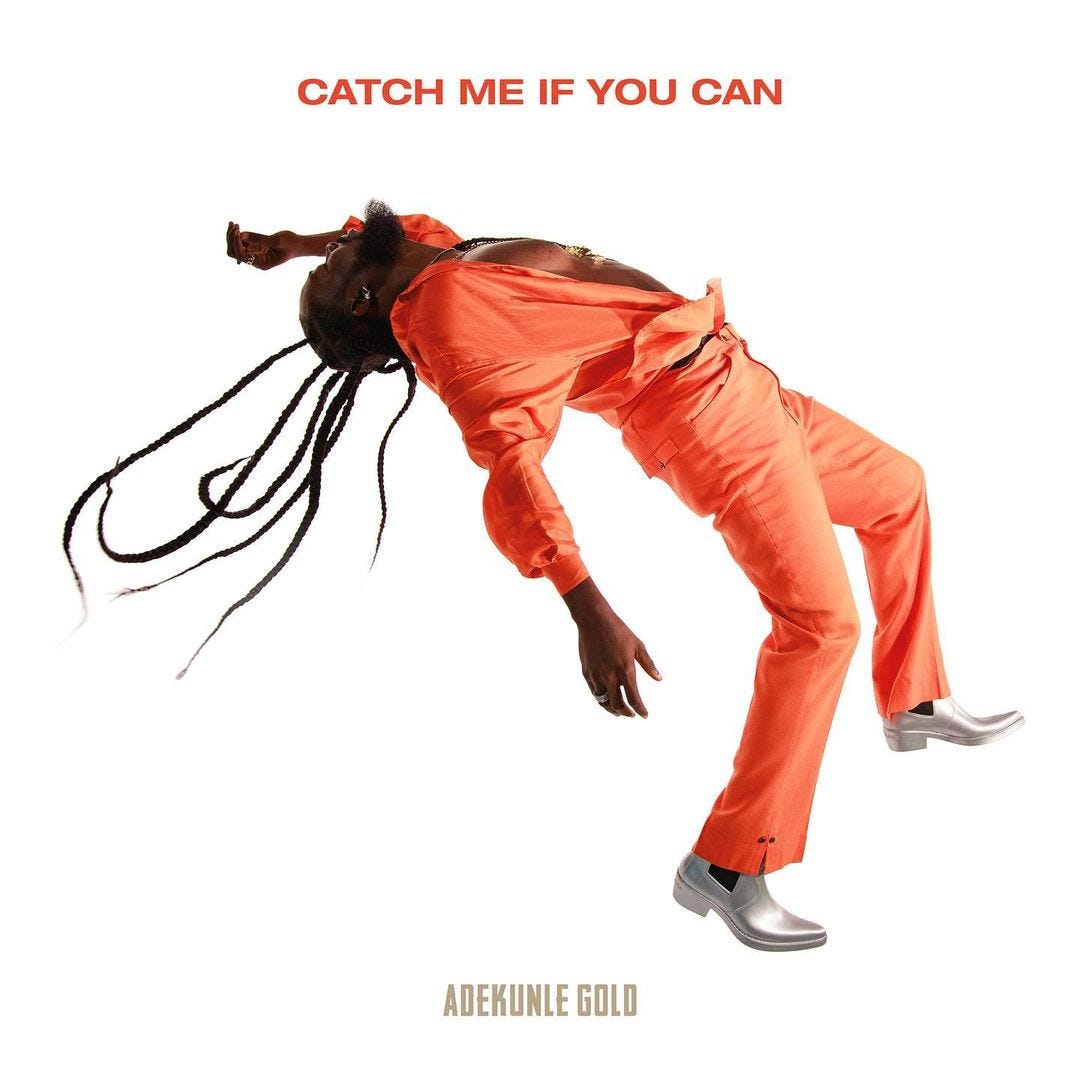
Adekunle Gold, the former Nigerian king of Photoshop and now one of the most vibrant music artists in Africa, is on cloud nine right now. Days after celebrating his birthday, he also churned out his fourth studio album, Catch Me If You Can, to commercial success.
The project is a cementation of Adekunle Gold’s transition to a full-fledged Afrobeats artist. His last album, Afro Pop Vol. 1, was an experiment that birthed some lovely tracks, attention and accolades.
With CMIYC, Adekunle Gold stands on a solid platform. His typical astute penmanship comes into play, while, for the first time, he is confident in his songs, says what he feels like and even uses some lewd lines when he feels they are necessary.

The opener welcomes the listener to the creative shift. “I have been living for people but me,” he says. It’s a self-confident, enhanced track and, in some way, a snapshot of what he has been through in the last two years. He has a kid. Fatoumata Diawara’s lush vocals come to his aid.
AG exudes confidence and positive affirmation on “Win” and “Mase Mi” (with a saxophone underneath). These run through a large chunk of the tracks.
Simi and Adejare are his muses on this album. He dedicated a track to the former; on “One Woman,” he co-opts the US rapper Ty Dolla $ign for a melodious, strings-filled track with an homage to the Igbo soup ofesala. When you hear me and my woman, AG should come to mind.
Adekunle Gold’s broadened sonic palette remains one of his unique selling points. Even after ditching Highlife and Juju to go mainstream, he still took some steps back to these genres. “Mercy” retains some elements of Galala, with an obvious homage to Baba Fryo’s classic record “Denge Pose”—I hope the recuperating artist gets some royalties off this song. The Highlife-spiced “More Than Enough” is a slow burner that reaches its crescendo when the trumpet collides with the drums. “Sinner” and “FYE” share similar themes. Their placement on the album makes for a seamless transition. Love into copulation, or in the reverse order.
When AG goes the emo way on “Sleep,” you just know something was not right. He struggles; not even his vocal flirtation could help him.
For a guy who started by serenading his better half with lovely tunes and at some point claimed she didn’t care if he had money (“Orente”), there was an obvious change of narrative via the Davido-assisted “High.” The first three lines—“Love is not enough / Baby come to me, Molowo / (come to me, Molowo)”—were an eye-opener. It currently has 10 million streams on Spotify—his highest ever.
Even though he claimed money doesn’t bring happiness on “It Is What It Is,” he was quick to pray for others to have money, apparently to prove or affirm his claim.
What’s an Adekunle Gold album without a track for his ex? From “Nurse Alabere” (Gold) to “Damn, Delilah” (About 30) and “My Ex” (Afro Pop), AG always has this penchant for striking something for his ex-girlfriends. It ranges from acerbic to sweet talk and half-pleading. He continued that streak with the percussion-driven “Selah”. The eponymous track ends with a voice note from one of his close pals, signalling what to expect in his artistic trajectory.
CMIYC is a stark, distinctive artistic rebirth of AG Baby and a further affirmation of his status as one of Africa’s most innovative artists.
 WhatsApp
 X
X
 Facebook
 LinkedIn