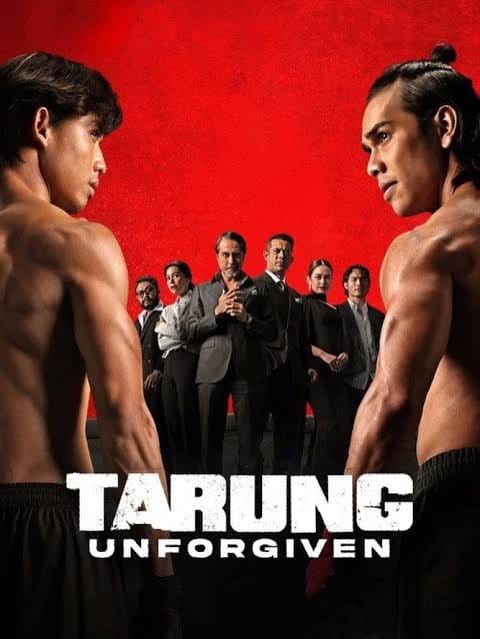
Action movies do not always need to surprise you to keep you interested. Sometimes the question is simply who will win the fight and what happens afterwards. But there are also films where the fights are not really the most important part. What matters more is why the characters are fighting in the first place. Tarung: Unforgiven, directed by Razaisyam Rashid, belongs more to the second group. Beneath all the punches, kicks, and silat fights, it is a story about two men carrying the weight of something that happened years ago.
so much about the outcome of the clashes than about two wounded men and their struggle with painful memories from the past.
Mierul Aiman plays Hatta, who was a champion in silat competitions but gave up fighting after unintentionally killing his opponent in the ring. Now, the protagonist spends his time working in the police department, but when he needs to raise money for his sick sister, Hatta joins an underground fighting circuit called MARGA.
As expected, his past does not remain unnoticed, and Hatta has to face his old friend Isa, played by Aedy Ashraf, who cannot forget how he was betrayed and hurt. From the very beginning of the movie, the audience knows that there will be a fight between these two characters, so the question becomes whether they will be able to face each other emotionally.
In my opinion, the predictability of the movie is its significant drawback. The premise of the film relies on well-known ideas of the reluctant fighter, the underground competition, the friendship turned into a rivalry, and the need for forgiveness versus revenge. This aspect was also pointed out by Malaysiakini in its review of the film. In this case, the only thing that matters is whether the characters are good enough to carry their roles. In fact, they are.
First of all, Aiman gives the hero an opportunity to present his character from the perspective of exhaustion instead of rage. The actor plays a man who is dragged into a world that he tried to forget for many years rather than a fighter who is eager for a comeback. Much of his best work is done in silence, as a glance can speak louder than any dialogue.
Secondly, Ashraf fits the role of Isa very well. This character could have been a stereotypical angry rival who simply opposes the main character, but he becomes something else because of the actor's performance. Ashraf shows the pain beneath Isa's anger, making his resentment understandable even if some of his actions are questionable. In this way, the history between the characters is not only the reason for their conflict but also an important way of showing their relationship to the audience.
Unfortunately, the script of the film does not make enough use of this aspect of the performances. Many times, the information conveyed by the characters' expressions is repeated by the lines of the script. In this way, the film often takes away the opportunity to leave things unsaid.
At the same time, the main idea of the film has the potential to move the audience emotionally. Hatta fights not for glory but because he needs the money. His participation in MARGA also forces him to face the guilt he has buried for many years. Isa, meanwhile, is so deeply involved in his resentment that it has become part of his identity. In fact, the title of the film has more meaning than it might seem at the beginning. The story is not simply focused on revenge but on two men who are unable to forgive each other because they have not forgiven themselves.
The choreography of silat is the most interesting feature of the film because it helps to differentiate it from many generic action movies. Aksiz also noticed this feature of the movie, and it is easy to see why. The fights feel realistic, with the sounds of the hits making the violence feel painful. People get exhausted and injured while performing the different moves.
Sometimes, however, the camera spoils the realistic feeling of the fights because the ring scenes are too dynamic to clearly see what the competitors are doing. The choreography is often faster than its representation on the screen, making some of the action difficult to follow.
There are also other elements of the story that could have become strong points but are underused in the film. MARGA, as an organisation, hints at an underground world that is hardly developed. Aksiz notes that some of the fights involving MARGA are just filler and have little to do with the main plot. This makes some of the action feel less important than it should.
Nevertheless, the supporting cast saves the film from becoming boring. Zul Ariffin presents a menacing figure in Badrul, while Bront Palarae makes an impression despite having little help from the script. Amir Ahnaf also adds some warmth to the film through his scenes with Hatta.
This is the pattern that runs through the whole story: the actors seem capable of presenting a better film than the screenplay allows.
In general, the final act of the film works because of the emotional connection created by Aiman and Ashraf. The result is already known beforehand, but thanks to the actors, the confrontation acquires real stakes. The film spends its time asking questions that are not physical but psychological: can these two men stop allowing the past to dictate their present lives?
In this way, the film succeeds despite its familiar storyline and predictable events, largely because of the characters presented by the actors. The pace is sometimes uneven, the dialogue is often redundant, and the development of some of the characters could be improved. Nevertheless, the actors give the story its life, while the choreography provides it with a strong physical aspect.
What the movie understands well is that Hatta's real enemy is not his opponent. It is the past he has spent years trying to run away from.
 WhatsApp
 X
X
 Facebook
 LinkedIn