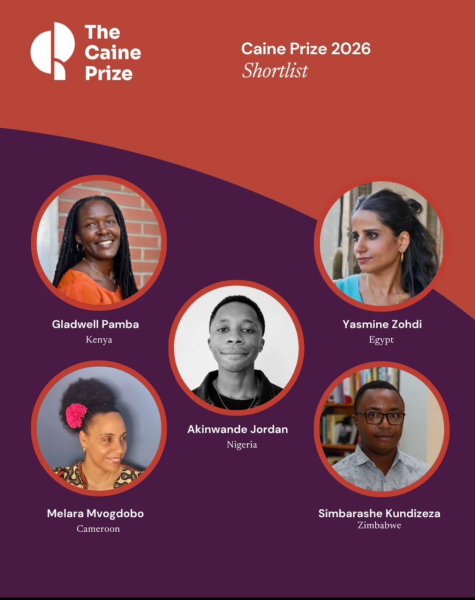
The most interesting thing about the 2026 Caine Prize shortlist may not be the five countries represented on it, but the places the five stories actually came from.
This year's finalists were published by Jahazi Press, Literatur.Review, Naira Books, The Republic and The Shallow Tales Review. They aren't five versions of the same kind of literary institution, and the stories didn't arrive through a single publishing route. Taken together, the shortlist offers a glimpse of an African fiction ecosystem that's becoming harder to describe through the old centres of literary power.
The five writers are Gladwell Pamba of Kenya, Melara Mvogdobo of Cameroon, Akinwande Remilekun Jordan of Nigeria, Yasmine Zohdi of Egypt and Simbarashe Steyn Kundizeza of Zimbabwe. Their stories were selected from 407 entries from 27 African countries, a substantial field for a prize that remains one of the continent's most closely watched awards for short fiction.
Looking at the list through its publishing history turns out to be useful.
Pamba's "The Last Shop" was published by Nairobi-based Jahazi Press in 2024. According to Ahmed Aidarus of Jahazi Press, the story is part of a wider movement in Kenyan fiction that's begun looking beyond the familiar political realism of the country's literary tradition. Pamba's story is also notable for where it's set: outside Nairobi, away from the city that so often becomes the default stage for contemporary Kenyan writing.
For Literatur.Review, Mvogdobo's "Dieu Merci!" represents another kind of intervention. The publication has made a point of creating space for writers who might not otherwise find an obvious route into the literary mainstream, and Mvogdobo herself has an unusual biography for a prize shortlist. Born in Lucerne in 1972, she has lived in Cameroon, Switzerland and the Dominican Republic, worked with traumatised young people, and published her first novel in 2023.
Jordan's route is different again. His "So Long Now It's Starting To Look Like Eternity" appeared through Naira Books. A writer, critic and editor whose interests move between cinema, literature, culture and politics, Jordan has built much of his work around questions of representation and African cultural production, and he's the only Nigerian writer on this year's shortlist. Kingsley Alumona, an editor at Naira Books, has singled out the story's poetic language and pacing.
Then there's Zohdi, whose "The Absence of Stains" appeared in The Republic. Based in Cairo, she works across fiction, translation and film criticism, previously served as culture editor at Mada Masr, and is a Berlinale Talent Press alumna. Chigozie Obioma, fiction editor at The Republic, has described the story as, in many ways, a masterpiece.
Kundizeza's "The Blue Fighter," published by The Shallow Tales Review, completes the list. The Zimbabwean writer lives in Harare and works as an associate editor at African Writer Magazine. His debut novel manuscript, Freelance, won the 2024 Island Prize for Debut African Fiction, which adds another useful detail to the picture: some of the writers arriving at the Caine Prize are already moving through several layers of the African literary ecosystem before the major prizes notice them.
Literary prizes can make a shortlist look more uniform than the publishing world behind it really is, and this year's entries are a good reminder why. The 2026 Caine submissions came from 27 countries, and the five selected stories passed through very different editorial environments before reaching the judges. There's an independent press in the mix, a literary review, an anthology publisher and publications with broader cultural ambitions. The shortlist isn't simply a list of five writers from five countries. It's also a record of editors, publishers and literary platforms deciding that particular stories were worth putting into circulation.
The judging panel, chaired by journalist and broadcaster Bola Mosuro, included Nana Ekua Brew-Hammond, Orsod Malik, Siphiwo Mahala and Sheila Atim MBE. Mosuro said the shortlisted stories distinguished themselves through their originality and emotional force, describing them as poignant, shocking, moving and quirky.
The range isn't surprising given the size of the field. What's more revealing is that the final five didn't emerge from a single dominant literary pipeline, which might be the quieter story underneath this year's shortlist.
African literature is often discussed as though it arrives at international attention from a handful of recognisable places: Lagos, Nairobi, Johannesburg, Cairo, perhaps a few European and American publishing houses beyond the continent. But writers don't necessarily begin there. A story can start in a workshop, appear in a small journal, pass through an independent press, find an editor willing to take a chance on it, and eventually turn up on an international prize list. Pamba's story travelled one version of that route, Mvogdobo's another, while Jordan, Zohdi and Kundizeza arrived through their own separate literary networks entirely.
The Caine Prize has long been interested in the short story as a form capable of catching writers before they become established novelists, and this year's shortlist reinforces that function. Pamba is working on a novel and a collection of short stories. Zohdi is working on her first novel. Kundizeza already has an award-winning novel manuscript. The prize isn't only recognising finished work; it's also identifying writers whose larger careers may still be taking shape.
All five shortlisted stories will appear in the annual Caine Prize Anthology, alongside work developed at this year's Caine Prize Workshop in Tanzania. The winner, who receives £10,000, will be announced at a ceremony in London in October before being celebrated in the winner's country of origin.
By then, the conversation will probably settle on a winner. For now, the more interesting question is what these five stories tell us before the envelope is opened, not what they say about "Africa" in the broad, familiar sense, but what they say about the writers, editors and small literary institutions currently deciding which African stories get to travel.
 WhatsApp
 X
X
 Facebook
 LinkedIn