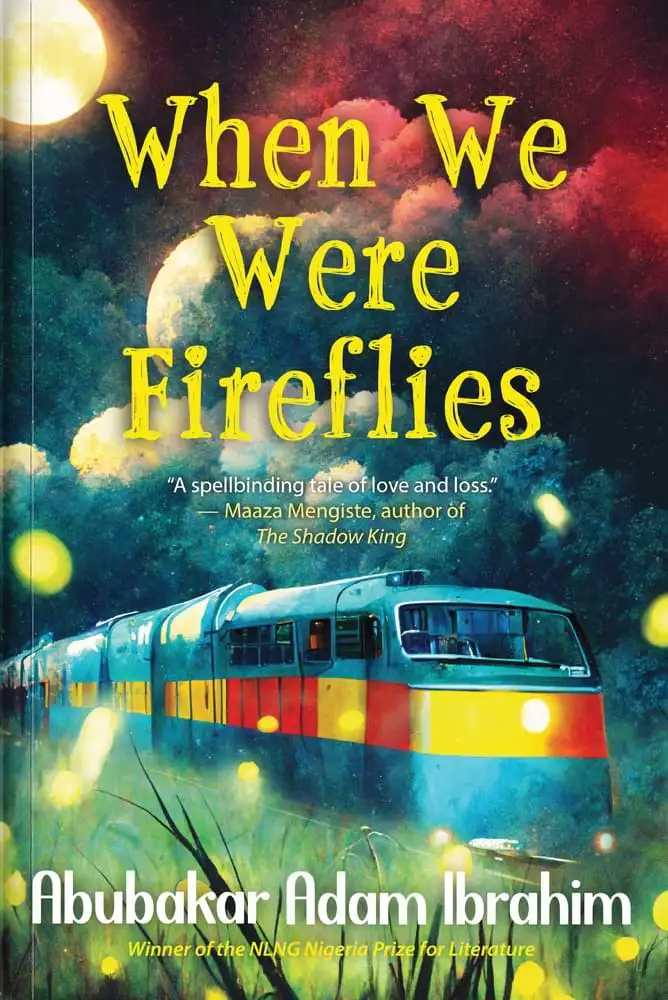
Abubakar Adam Ibrahim’s When We Were Fireflies is a novel about a man discovering that one lifetime may not be enough to contain a person.
Yarima Lalo is an artist, a man in love, and, at first, an apparently ordinary inhabitant of the world. Then something happens on a train that unsettles the logic of his life. He remembers a death that has not happened in this lifetime. The memory is not a dream or a vague sensation. It carries the force of recognition. The place is familiar because he has been there before, as someone else.
From that point, Ibrahim opens up a strange proposition. Lalo has lived other lives. He has entered other bodies, loved other people and died more than once. The past is not dead because it is inside him. What he has forgotten has merely been waiting for the right moment to return.
This is where the novel becomes more interesting than its supernatural premise.
Ibrahim is really concerned with the things people carry from one version of themselves into another. We change constantly, sometimes so thoroughly that the person we were ten or twenty years ago can seem like a stranger. Yet we continue to call ourselves by the same name. Memory performs the work of joining those scattered selves together.
Lalo experiences that problem in its most literal form. He cannot simply remember and move on. His memories complicate the present. Old loves, old deaths and old wounds begin to acquire new meaning. The life he thought was his alone becomes crowded with the lives that preceded it.
It is an idea Ibrahim handles with considerable imagination because When We Were Fireflies never treats memory as merely sentimental. Memory here has consequences. It can unsettle identity, reopen grief and force a person to reconsider what he thought he understood about himself. The past is not a museum Lalo visits. It is an active presence.
And then there is love.
Lalo's relationship with Aziza gives the novel its human urgency. Without it, the machinery of reincarnation could easily have become an elaborate philosophical exercise. Instead, love gives Lalo something to lose and, eventually, something worth risking himself for. His journey through previous lives is also a search for an explanation of why he keeps returning to the same emotional terrain.
The novel's strongest achievement, however, may be its world.
Ibrahim has a particularly good eye for the small physical details that make a fictional place feel inhabited. Food, streets, shops, artists at work, a woman running her henna business, children moving through the city: these details keep the novel grounded even when its story moves into the territory of spirits and the afterlife.
There are stranger images too. A child spirit pushing a trolley through the streets. Figures whose business is the collection of souls. Lalo moving from one city to another with Aziza. These things could have belonged to entirely different kinds of novels. Ibrahim brings them into the same landscape and, for the most part, makes their coexistence feel natural.
That quality was already present in Season of Crimson Blossoms, where San Siro became more than a location. In When We Were Fireflies, Ibrahim extends that gift across Northern Nigeria.
Jos, Abuja, Kafanchan, Kaduna and Maiduguri are not interchangeable stops on Lalo's journey. Each carries its own history and atmosphere. Ibrahim allows the differences between them to register without turning the novel into a catalogue of regional identities. The cities become part of the movement of the story, changing the texture of Lalo's experience as he passes through them.
This is also where the novel raises questions that Ibrahim does not always pursue as far as I might have wanted. Northern Nigerian fiction has an enormous political and historical landscape to work with. The region's upheavals, transformations and contradictions could sustain many novels. I often want writers from the North to press harder into that material.
But that is not necessarily a failure of this particular book. Ibrahim is doing something else here. His interest is less in diagnosing Northern Nigeria than in allowing its cities and people to form the physical world of a story about memory, death and love.
The novel's literary conversations are also worth noticing. Ibrahim acknowledges Gabriel García Márquez, including through Leaf Storm, and the presence of magical realism is obvious enough without becoming a simple exercise in imitation. There is also something almost mischievous in the way the novel's railway encounters recall Tolstoy's Anna Karenina. But where the train in Tolstoy becomes part of a tragic romantic trajectory, Ibrahim uses the encounter to set his characters on a much stranger route, one in which love has the possibility of saving rather than destroying.
Ibrahim's prose is at its best when he trusts the image.
There are moments when a physical detail becomes more disturbing or beautiful because of the way he places it in the sentence. The grotesque can sit beside the ordinary without announcing itself as grotesque. A meal, a painting, a social-media post or an encounter in the street can exist alongside spirits and reincarnation without the novel having to keep reminding us that something supernatural is happening.
That is why the book's atmosphere lingers.
While reading it, I often found myself less interested in getting to the next revelation than in staying inside the world Ibrahim had made. That is an important distinction. Some novels are built primarily around what happens next. When We Were Fireflies has plenty of plot, but some of its pleasure comes from simply being in its company.
The book is not without its weaknesses. Ibrahim sometimes explains the moral implications of his story more directly than necessary. There are places where the novel seems determined to tell us what Lalo's experiences mean instead of allowing the experiences themselves to carry the argument.
Its eventual preference for forgiveness over revenge is clear. It is a worthwhile conclusion, but the novel occasionally works too hard to arrive at it.
Fortunately, the book is more interesting than its lesson.
What stays with me is the larger question underneath Lalo's strange existence: how many lives can a person live inside one life? The child we were is gone. The young person we once imagined becoming may also have disappeared. People we loved leave us with versions of ourselves that no longer exist anywhere except in memory.
Ibrahim takes that familiar human experience and gives it a supernatural form.
The result is a novel in which the dead are not entirely dead and the living are never entirely free of the people they used to be. Its ghosts are not simply creatures from another world. They are the accumulated selves, loves and losses that make up a human life.
That is what makes When We Were Fireflies stand out.
It is ambitious without being merely ambitious. It is strange without losing its emotional footing. And beneath its spirits, reincarnations and journeys through Northern Nigerian cities is a recognisable human problem: how to live with everything we have been, everything we have lost, and everything we have yet to become.
For me, it remains one of the more memorable Nigerian novels of its generation.
 WhatsApp
 X
X
 Facebook
 LinkedIn