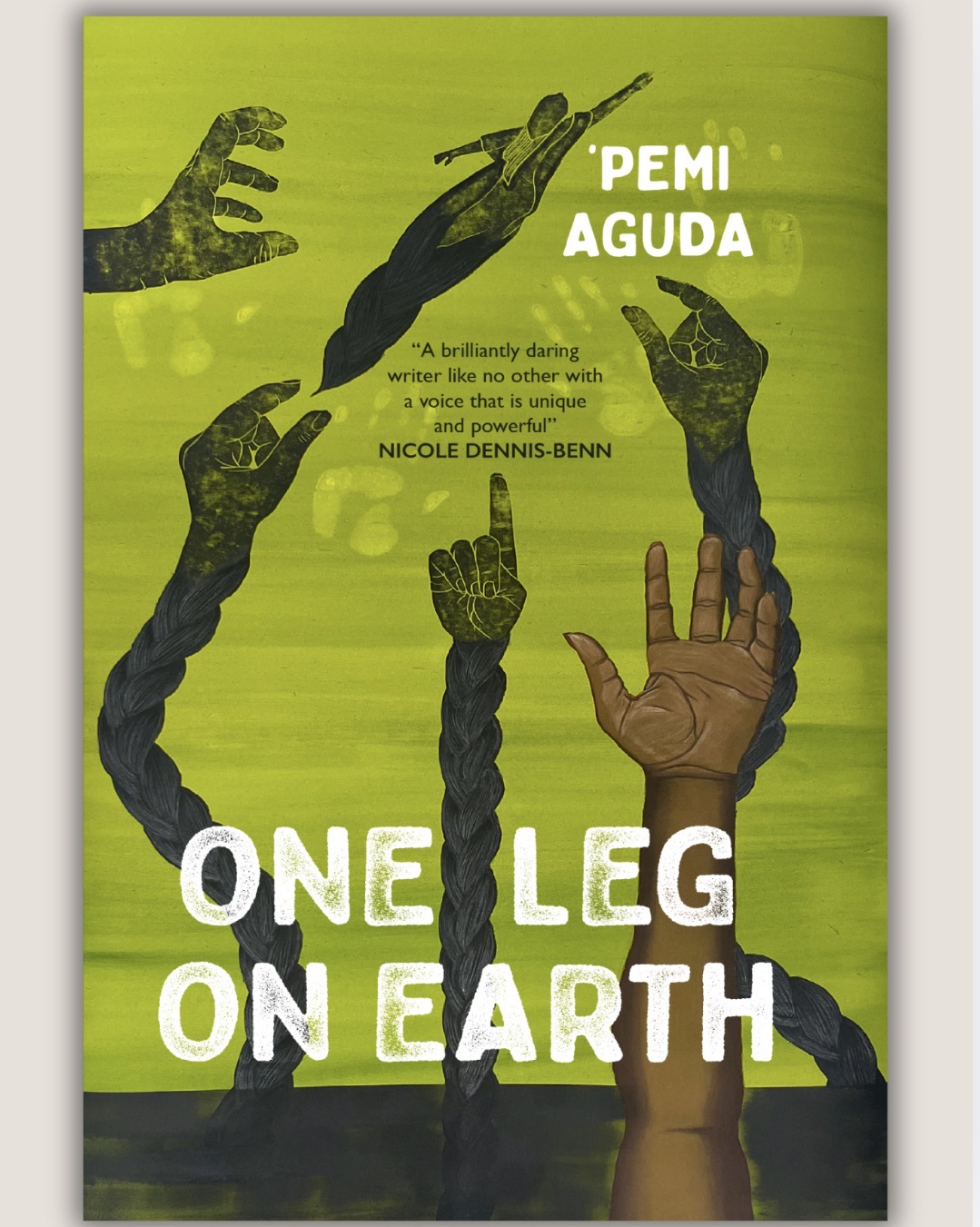
The trouble in Pemi Aguda’s One Leg on Earth begins with pregnant women walking into the water. They do not appear to be fleeing anyone. They simply walk into Lagos’s waters and drown. Yosoye Bakare, a 23-year-old NYSC member who has just arrived in the city, soon finds herself trying to understand why.
Yosoye has studied Mass Communication and has been placed at an architecture firm working on Omi City, a major land reclamation project. She is excited to be in Lagos. The city represents the kind of life she has wanted for herself, and her new job gives her a way into it. Then she becomes pregnant after a one-night stand. The timing is unsettling. Pregnant women are dying across the city, apparently by suicide, and Yosoye soon encounters the body of one of them. As the deaths continue, she begins to wonder whether they have anything to do with Omi City or with the strange things she has started experiencing herself.
Aguda builds the novel around that uncertainty. There is no single explanation waiting to make everything fall into place. One Leg on Earth moves between literary fiction, horror, folklore and the supernatural while remaining firmly rooted in the ordinary pressures of Lagos life. That combination works surprisingly well.

The Lagos of the novel is not simply a backdrop for the horror. Yosoye experiences the city through its traffic, heat, social life and constant movement, but she is also drawn to its glamour. Her new workplace offers proximity to a future Lagos that is being marketed as modern, wealthy and desirable. She wants access to that future.
Omi City is fictional, but its land reclamation and luxury development inevitably bring Eko Atlantic to mind. The comparison is not difficult to make, particularly for readers who know Lagos. Aguda uses the project to place two versions of the city beside each other: one crowded and difficult, the other promising space, exclusivity and a carefully planned future.
What makes this more interesting is that Yosoye does not initially stand outside that tension. She is not the conventional protagonist who arrives in Lagos already equipped to expose its inequalities. She is seduced by the city. She wants the job, the independence and the possibility of becoming someone different from the person she was in Ibadan. Omi City represents a version of that transformation.
Her pregnancy complicates the fantasy.
The pregnancy gives Yosoye something she can hold on to while she is still trying to establish herself. She begins to see motherhood as a source of belonging. At the same time, her changing body places her closer to the mystery unfolding around her. The novel repeatedly brings together pregnancy, water, construction and the body, creating a network of images in which creation and destruction exist uneasily beside each other.
Aguda handles motherhood without reducing it to either a blessing or a burden. Yosoye's feelings are mixed. She is young and uncertain, but she also sees the pregnancy as something that might fill a loneliness she has carried for years. That emotional ambiguity is important because the novel's horror does not depend solely on the supernatural. It grows from a situation that is already psychologically complicated.
Aguda is particularly good at making ordinary places feel unsafe. A walk home, a conversation at work or an encounter near the water can suddenly acquire a different meaning. Her prose moves quickly, and the strange moments do not always arrive with the warning signs associated with conventional horror. The effect is often genuinely unsettling.
There is also a physical quality to the novel's imagery. Water, pregnancy, construction and the body recur throughout the book, but Aguda does not always explain what they are supposed to mean. The reader has to live with the uncertainty. At its best, this restraint gives the novel its unease. Not everything needs to be decoded for a supernatural story to work.
The difficulty is that One Leg on Earth sometimes withholds information without replacing it with enough emotional or narrative development. The questions remain interesting, but after a point the reader may begin to wonder whether the novel is deliberately mysterious or simply unwilling to answer them. The distinction matters.
This is particularly evident in the novel's treatment of its larger social concerns. Omi City raises questions about land, wealth and who gets to participate in Lagos's future. The deaths of pregnant women add another dimension to that conflict, drawing attention to differences in vulnerability, wealth and protection. Aguda is more convincing when these questions emerge naturally from Yosoye's experience than when the symbolism becomes too obvious.
The strongest version of the novel would make those connections feel inseparable from character. Sometimes they do. At other times, the ideas seem to arrive before the people who are meant to carry them.
That is the central weakness of Yosoye.
She is an interesting protagonist, but she does not always feel as fully developed as the world around her. Her loneliness, ambition and complicated relationship with motherhood are clear enough. Her desire for Lagos is also convincing. But some of her decisions seem to serve the novel's larger ideas more than they arise naturally from the character we have come to know.
That becomes a problem because so much of the novel depends on her. Almost everything is filtered through Yosoye's experience. When she feels emotionally distant, the story loses some of its force.
The supporting characters sometimes have the opposite problem. They are memorable because Aguda gives them strong details and distinct positions within Yosoye's life, but several seem to exist mainly in relation to the questions the novel wants to explore. They can feel like carriers of an idea—about family, motherhood, class, gender or Lagos—rather than people whose lives would remain compelling outside the novel's central mystery.
This is where Aguda's transition from Ghostroots becomes significant. Her earlier collection was praised for its treatment of Lagos, family, violence and the supernatural. One Leg on Earth extends many of those interests into a full-length narrative, but the change in scale creates a different demand.
A short story can sustain an unsettling image or unresolved question for a few pages. A novel has to keep the reader invested in the people living through those uncertainties. Aguda does not always manage that balance. The atmosphere remains strong, but the longer form exposes places where the characters need more development than the novel gives them.
That does not make One Leg on Earth unsuccessful. In fact, some of its most compelling qualities come from the same ambition that creates its weaknesses. Aguda is attempting to connect motherhood, urban development, class and supernatural horror without treating any of them as decorative additions to the others. The novel's Lagos feels like a place where those forces can naturally collide.
The supernatural elements, importantly, do not feel imported from somewhere else and simply placed against an African setting. They grow out of the city's geography, history and anxieties about the way it is being rebuilt. Water is not merely an atmospheric horror device. It is part of Lagos's physical reality. Construction is not simply a symbol. It is part of the city's relentless transformation. Pregnancy is not merely a metaphor for creation. It is Yosoye's immediate physical experience.
When these elements converge, Aguda is at her most convincing.
The ending is where the novel's weaknesses become hardest to overlook.
By then, the story has accumulated questions about the women in the water, Omi City, Yosoye's pregnancy and the forces surrounding them. The final movement does not resolve all of those questions. There is nothing inherently wrong with an open ending; horror, folklore and literary fiction can all benefit from uncertainty. The question is whether the uncertainty feels earned.
In One Leg on Earth, it sometimes does. At other points, it feels as though the novel has asked the reader to do more work than the characters and story have quite earned.
The problem is therefore not that Aguda refuses to explain everything. It is that some of the withheld information does not produce a sufficiently strong emotional consequence. Mystery can deepen a story when the reader understands what the characters stand to lose even without understanding exactly what is happening. Here, the novel occasionally leaves both the mystery and the emotional stakes less developed than they could have been.
Still, there is enough here to make the novel worth taking seriously.
Aguda has a strong sense of place and an unusually confident command of atmosphere. She understands how a familiar city can become strange without ceasing to be recognisable. She also has the imagination to bring together motherhood, urban development and horror in ways that are often genuinely unsettling.
More importantly, the novel has a point of view about Lagos. Yosoye's attraction to Omi City's promise is not incidental. She wants the future the novel is asking us to question. That tension gives the book more complexity than a straightforward critique of luxury development would have had.
The novel does not completely fulfil the promise of its premise. Yosoye could have been developed further, several supporting characters remain more functional than fully realised, and the final pages leave some of the story's most important questions less settled than they need to be. But its weaknesses are inseparable from its ambition. Aguda is attempting something larger than a conventional ghost story or a straightforward novel about motherhood.
One Leg on Earth is an ambitious, atmospheric debut that succeeds more consistently in setting and idea than in character and resolution. Aguda's Lagos is vivid, her prose is assured, and the novel has a genuinely unsettling premise. Its central mystery, however, is not always matched by an equally satisfying narrative development.
It is an uneven novel, but an interesting one. The parts that work are difficult to dismiss, and the parts that do not are difficult to ignore.
 WhatsApp
 X
X
 Facebook
 LinkedIn